
Zero-Based Budgeting vs. 50/30/20: Which Method Works Better?
Which budget type to choose? We’ve made it easy for you with this clear breakdown of how they compare!

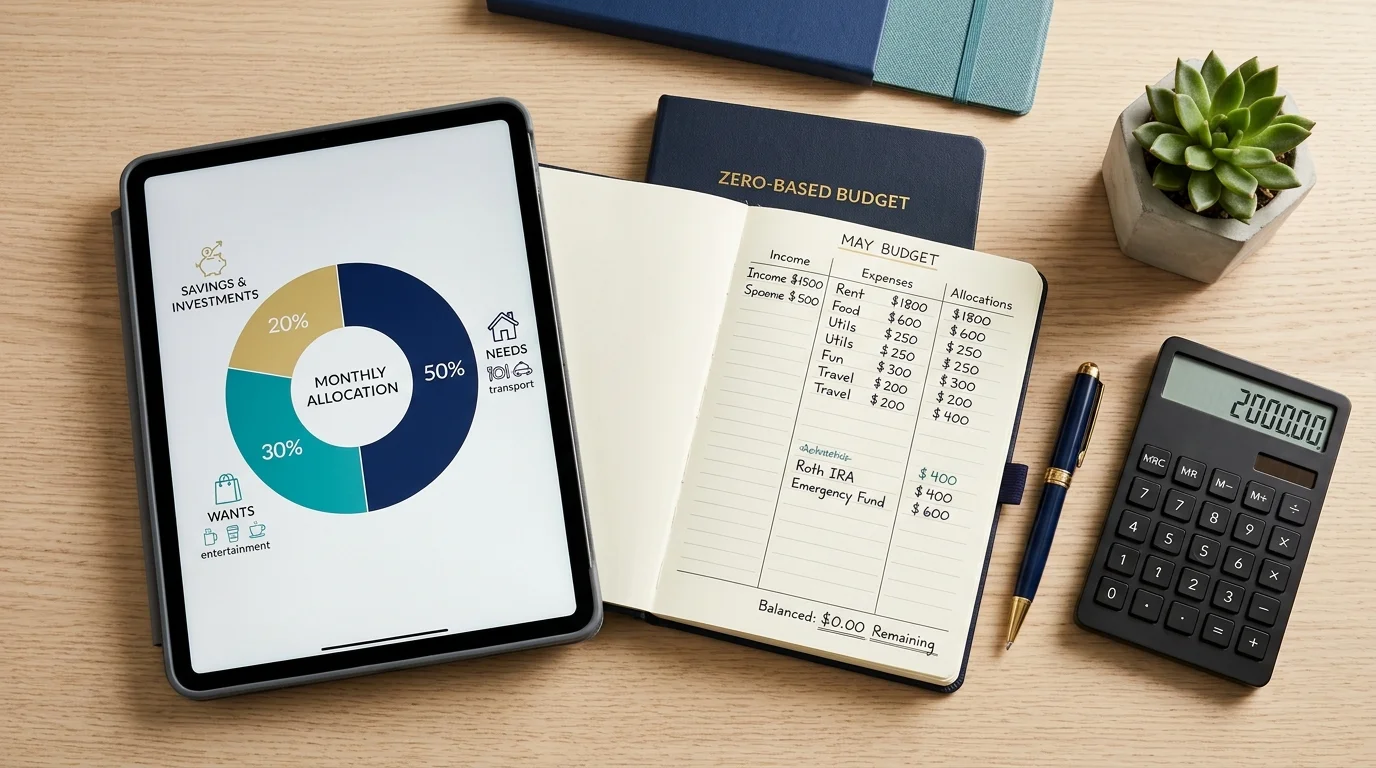
Table of Contents
There are many different ways people approach budgeting! However, traditionally people often get stuck between picking either Zero Based Budgeting (ZBB) or the 50/30/20 Rule. The wrong choice for your personality type is likely to cause you to fail budgeting in less than 60 days.
When choosing a budgeting method, you will want to pick an option that you can easily stick to month after month. Consider the facts below carefully so you choose the right budgeting method to make the most progress towards your financial goals.
Under Zero Based Budgeting, every dollar of income received will be allocated to a category so that at the end of the month, you have $0 left unallocated. Under the 50/30/20 Rule, you allocate your net income to three different categories: 50% Needs, 30% Wants and 20% Savings and Debt repayment.
Example: $5,000 Monthly Net Income Comparison
Below shows an example of how much could be saved using each budgeting strategy with a $5,000 monthly net income:
| Category | 50/30/20 Rule | Zero Based Budgeting |
|---|---|---|
| Needs / Fixed Costs Rent, Power/Water, Food and Car Insurance |
$2,500 (50%) | $2,420 $1,600 (Rent), $220 (Power/Water), $400 (Food), $200 (Car Insurance) |
| Wants / Flexible Eating out, Entertainment, Shopping |
$1,500 (30%) | $780 $250 (Eating out), $50 (Subscriptions), $80 (Gym), $400 (Personal) |
| Savings / Accelerated Debt Repayment Emergency fund, Roth IRA, Additional Debt repayment |
$1,000 (20%) | $1,800 $600 (High Interest Account), $600 (Roth IRA), $600 (Additional Debt) |
| Leftover Money | $0 | $0.00 |
Key Considerations: Within the 50/30/20 Rule, individuals are able to save $1,500 a month on ‘Wants,’ making this a great option for those with a generous source of income who wish to have more flexibility. Within Zero Based Budgeting, every single dollar is given attention. As a committed person looking to increase savings, you can save an extra $800 per month to accelerate your wealth building.
The 50/30/20 Rule
Often popularised by Senator Elizabeth Warren within her book All Your Worth, the 50/30/20 Rule is very easy to follow and sustainable:
- 50% Needs – Essential costs. These include things such as housing, food, electricity, and transport. This is the minimum amount you would have to spend to survive if you were to lose your job.
- 30% Wants – Things you would like to spend money on to improve your quality of life. This could include dining out, subscriptions, going to concerts, holidaying, and buying branded clothes.
- 20% Savings & Debt – Create future security. This includes putting money into an emergency fund, contributing to your 401(k) or Roth IRA account, and paying off credit cards or student loans (above the minimum payment).
With this method, you do not need to track what specific things you have spent money on within ‘Wants’. As long as you ensure you are not spending more than 30% in wants, and 50% in needs, you will be good to go.
Zero Based Budgeting
Zero Based Budgeting is a technique adapted from business finance. Essentially, this budgeting method ensures you end up with exactly $0 in your budget: (Income − Expenditure = $0).
Before the month begins, you must assign every single dollar of income (in this example, $4,800) to different categories in your budget. This includes paying fixed bills, food, fuel, creating a sinking fund, accelerating debt repayment, and investing so that at the end of the month, there is no money left unallocated in your bank account.
This does not mean that your bank account will be $0. It simply means that you have allocated all of your money, and therefore have $0 left to spend in your planned budget. Any leftover money is very risky as it is likely to be spent very carelessly.
Zero Based Budgeting can cause burnout. If you live an extremely busy life, or do not enjoy spending time entering information, you may become burnt out from entering your expenditure regularly. This may mean you give up on budgeting within 90 days.
Comparison: Which Method Fits Your Financial Life?
Consider the following factors to decide which budgeting method best suits your financial life:
| Factor | 50/30/20 Rule | Zero Based Budgeting |
|---|---|---|
| Effort Involved | Low (15–30 mins per month) | Moderate–High (10–15 mins per week) |
| Best For | Individuals with steady income, no debt, and minimalists. | Accelerated debt repayment, low income earners, and analytical planners. |
| Flexibility | Very flexible | Fixed; you will need to adapt if expenditure changes. |
| Speed of Debt Repayment | Moderate (Max of 20%) | Fastest (All excess money goes to paying off debt). |
| Recommended Apps | Basic notifications in bank app, or spreadsheet. | YNAB (You Need A Budget) or EveryDollar. |
The Hybrid Option: Combine Both Methods
You do not need to stick to just one budgeting method. In fact, experienced financial planners often recommend using a hybrid approach:
- Zero Based Budgeting (Sprint): If you have high-interest credit card debt, no emergency fund, or simply feel that you struggle to hold onto money, try using Zero Based Budgeting for 6–12 months. This will allow you to become stricter with your money to create your first 6-month emergency fund and pay off consumer debt.
- 50/30/20 Rule (Cruise): Once you have paid off high-interest debt and have 6 months’ cushion in cash, consider switching to the 50/30/20 Rule. Simply save automatically 20% of your income, pay 50% of fixed costs, and spend 30% on ‘Wants’ without any guilt or spreadsheet effort!
Use our free Monthly Budget Calculator to work out the best amount for your 50/30/20 rule, or adjust individual lines of expenditure.
Frequently Asked Questions
What if I spend more than 50% on Needs?
In larger cities, rent and utility costs can mean that you spend over 50% of your net income on ‘Needs’. If this is the case, you may want to try adjusting to the 70/20/10 Rule (70% Needs, 20% Savings/Debt, 10% Wants). In the long term, try working on some of the Big Wins to reduce your costs. Perhaps negotiate a lower rent, get a flatmate, downsize your expensive car lease, or increase your income.
Can I still have fun with Zero Based Budgeting?
Absolutely! Within Zero Based Budgeting, create a category called ‘Fun without Guilt’ or ‘Eating out’. Put a certain amount in this category (for example $250) and spend all of it with no guilt. Since this has already been considered in your calculation, you will end up with $0 in your budget.
How do I incorporate 401(k) retirement savings?
As pre-tax contributions are taken directly from your pay, they count towards your savings (20%). To accurately calculate your 50/30/20 Rule, add your monthly 401(k) contribution to your net income to get a ‘Gross Post Tax Baseline’. From here you can apply the percentages.
Can I use both methods?
Yes! Many people successfully incorporate both methods. They use the 50/30/20 Rule for general budgeting throughout the year, and use Zero Based Budgeting weekly within the ‘Wants’ section of their budget.
Financial Disclaimer: This article is published for educational and informational purposes only and does not constitute personalized financial, legal, or investment advice. Always consult with a licensed fiduciary financial advisor before making significant financial commitments.
Editorial Standards: Our writers and editors uphold strict standards of editorial independence. Advertising or partner compensation does not influence our research, ratings, or advice.
Editorial Team
Managing Editor & Site AdministratorThe MoneyWise editorial team is dedicated to producing actionable, unbiased, and mathematically sound personal finance guidance for US consumers.
Related Articles
View all
How to Save $5,000 in 6 Months: The Exact Bi-Weekly Paycheck Blueprint
Nov 20, 2026 • 5 min read
50/30/20 vs. 70/20/10 vs. 60/20/20: Which Budget Percentage Rule Actually Works?
Nov 20, 2026 • 5 min read
The Automated Money Funnel: How to Save $10,000 in One Year
Nov 17, 2026 • 5 min read
The 30-Day No-Spend Challenge: Rules, Tips & Survival Guide
Nov 17, 2026 • 5 min readGet Practical Money Tips in Your Inbox
Join our newsletter and receive the latest articles, tips and tools straight to your email.
Build a Stronger Financial Future
Explore our free calculators and resources to make smarter money decisions.
Try Free Calculators