
Cash Stuffing & Digital Envelopes: Complete Beginner's Guide
Use physical cash envelopes to help stop you overspending. Or try using safe digital envelopes.

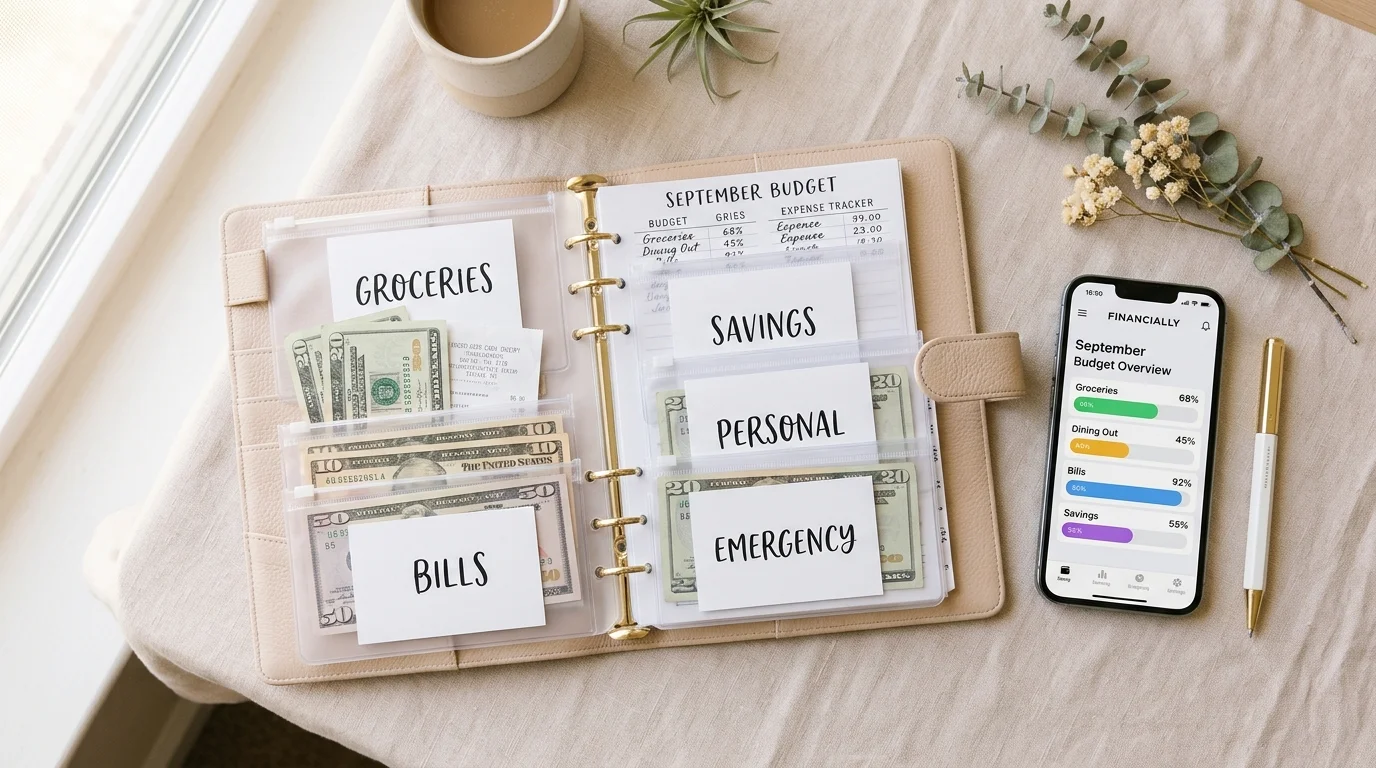
Table of Contents
With so many easy ways to spend money now, such as Apple Pay, 1 click purchasing and touch payment cards, it has never been easier to lose control of your money. As we do not actually physically see the money leaving our hands, our brains cannot fully comprehend that we are losing money. For this reason millions of people are turning to a cash stuffing budgeting technique.
Benefits of Cash Stuffing
Whilst the aesthetic of cash stuffing budgets is very popular on social media, with pastel folders and labelled vinyl wallets, the psychology behind this type of budgeting comes from behavioural economics. When done properly, cash stuffing budgets can completely prevent overspending in flexible areas of your budget including eating out, fashion and entertainment.
Cash stuffing is when you take cash from your bank to spend in a specific category, putting it into envelopes or pockets within a folder. Once all your cash in that envelope is spent, you can no longer spend in that category until the next month.
Why Does Cash Stuffing Reduce Overspending?
Studies based on neuroscience and behavioural economics (by Carnegie Mellon and MIT), have shown that using physical cash in transactions causes the part of our brain known as the insula to activate. The insula is activated in situations of pain and discomfort. So, paying with five $20 notes physically causes an extreme feeling of pain in your brain.
However, if you pay with a credit card or two taps on your phone, this pain is greatly reduced. As you get a hit of dopamine from making the purchase, but the actual cost will not be felt until weeks later when you get your monthly statement. Cash stuffing brings back some good discipline to your money choices.
Cash Stuffing vs Digital Envelope Budgeting vs Credit Cards
Before implementing your envelope budgeting system, consider the following to understand which method will suit your lifestyle best:
| Feature | Physical Cash Stuffing | Digital Envelope Budgeting | Traditional Credit Card |
|---|---|---|---|
| Control of Impulse Spending | Very Good (You can no longer spend once your envelope is empty) | Good (Under budget amounts, and notifications) | Poor (Easy to overspend) |
| Security / Insurance | High Risk (No insurance if stolen/lost) | Insured up to $250,000 by FDIC | Zero liability for fraud |
| Earn Interest | 0% APY (Loses value to inflation) | Earn 4-5% APY in High Yield Accounts | 0% (Will accrue 20%+ APR interest if not paid) |
| Convenience for Bills | Poor (Can’t pay bills online such as utility bills, mortgages) | Very Good (Automated bill payments) | Very Good (Receive rewards for automatic payments) |
| Best for | Flexible spending problems | Full budgeting in modern households | Responsible spenders who can pay full amounts each month |
5 Best Areas To Cash Stuff
A common mistake made by people starting cash stuffing is trying to take too much of their salary in cash. Fixed bills such as rent, mortgage repayments, car loan repayments, electricity and health insurance should always be kept in your digital account and automatically paid by ACH.
Only flexible, discretionary spending should be put into cash envelopes:
- Grocery Shopping: You will avoid being tempted to buy snacks, products on promotion and upcharging for branded items.
- Restaurants/Coffee Shops: You will now have a set amount to spend on eating out on Fridays, lunch and coffee in the mornings.
- Beauty: Hair cuts, Manicures, Skincare Products & Beauty Products.
- Entertainment: Films, happy hours, sports and hanging out with friends.
- Spending Cash: Gives you an easy $40-$60 guilt free budget for small treats without having to track the money.
• Groceries: $450 ($112.50 per week)
• Eating out & Coffee: $200 ($50 per weekend)
• Beauty: $100
• Entertainment: $120
• Miscellaneous: $80
Digital Envelope Budgeting
Although cash stuffing is great at helping break bad spending habits, it can be risky to keep large amounts of cash in paper form in your house. Theft, fire, and misplacing cash could result in you losing your money. In addition, currently, High Yield Savings Accounts offer a 4-5% APY (from FDIC insurance). Leaving large amounts of cash in paper form means that you are losing hundreds of dollars in interest.
To solve this issue, try a digital envelope budget. This can be easily set up in several ways:
- Multiple Sub-Accounts (Vault Method): Many apps such as Ally Bank, Capital One 360 and SoFi allow multiple sub accounts within the same login. Create multiple accounts and name them according to what you want to save for e.g. ‘grocery’, ‘entertainment’ and ‘Christmas’.
- Multiple Cards: Open two checking accounts and have two debit cards. Debit card A can be used for only automatic fixed bills. Debit card B can be used for only your discretionary monthly allowance. Once there is $0 in this account, you cannot spend any more in this category.
- Apps: Apps like Qube Money allow you to create digital envelope debit cards. At a shop, open up the app and select the relevant envelope to spend from (e.g. ‘eating out’) and the card will become temporarily unlocked so you can only spend the pre-set amount.
Do NOT keep large emergency funds in physical cash in your home. It is fine to keep between $300-$800 in cash for monthly groceries and eating out. However, for emergency and long term funds, do NOT keep it in physical cash. Typically, house / renters insurance will only cover a maximum of $200-$1000 of stolen cash.
How To Get Started
- Find your Discretionary Allowance: Use our Monthly Budget Calculator to calculate your exact discretionary allowance.
- Choose your Method: If you have significant credit card debt, try cash stuffing for 60-90 days in order to change your behaviour. If you are debt free, try setting up multiple sub-accounts.
- Split Your Envelope into Weekly Allowances: We recommend splitting your monthly allowance into 4 weekly allowances so that you do not have the whole month of cash in your wallet. Place 3/4 of your cash securely at home.
- Don’t Over-spend: If you run out of money in your eating out envelope on day 20 of the month, do not move money from other envelopes. Eat from your cupboard until the 1st of next month. This will build great confidence with money.
To learn how to combine envelope budgeting with long term goals, read our full guide on Sinking Funds 101.
Frequently Asked Questions
What to do if I have leftover money in my envelope?
This is a great achievement! For building wealth, either add it to your emergency fund (read our guide on How to Build a 6 Month Emergency Fund Fast), add as extra principal to pay off debts (use our Debt Snowball Calculator), or leave it in the envelope as extra insurance for next month.
Can I move money from one envelope to another?
Try to avoid doing this. If you get into the habit of moving money from one envelope to another (“robbing Peter to pay Paul”) then you will lose the accountability element of this budget. In an emergency, make changes to your written budget instead of moving money between envelopes.
How can I make online purchases if I am cash stuffing?
Either deposit the correct amount of cash back into your current account or try a digital envelope. The added effort to go to a bank / ATM to deposit cash before making online purchases can be a good way to prevent impulsive late night purchases.
Is cash stuffing suitable for high earners?
For high earners, physical cash stuffing can be very tedious to do with large amounts of money to budget. For high income households it is much better to use the Digital Envelope System, or Conscious Spending Plan. These systems allow you to build wealth efficiently, whilst still having a clear record of money and protection from fraud.
Financial Disclaimer: This article is published for educational and informational purposes only and does not constitute personalized financial, legal, or investment advice. Always consult with a licensed fiduciary financial advisor before making significant financial commitments.
Editorial Standards: Our writers and editors uphold strict standards of editorial independence. Advertising or partner compensation does not influence our research, ratings, or advice.
Editorial Team
Managing Editor & Site AdministratorThe MoneyWise editorial team is dedicated to producing actionable, unbiased, and mathematically sound personal finance guidance for US consumers.
Related Articles
View all
How to Save $5,000 in 6 Months: The Exact Bi-Weekly Paycheck Blueprint
Nov 20, 2026 • 5 min read
50/30/20 vs. 70/20/10 vs. 60/20/20: Which Budget Percentage Rule Actually Works?
Nov 20, 2026 • 5 min read
The Automated Money Funnel: How to Save $10,000 in One Year
Nov 17, 2026 • 5 min read
The 30-Day No-Spend Challenge: Rules, Tips & Survival Guide
Nov 17, 2026 • 5 min readGet Practical Money Tips in Your Inbox
Join our newsletter and receive the latest articles, tips and tools straight to your email.
Build a Stronger Financial Future
Explore our free calculators and resources to make smarter money decisions.
Try Free Calculators